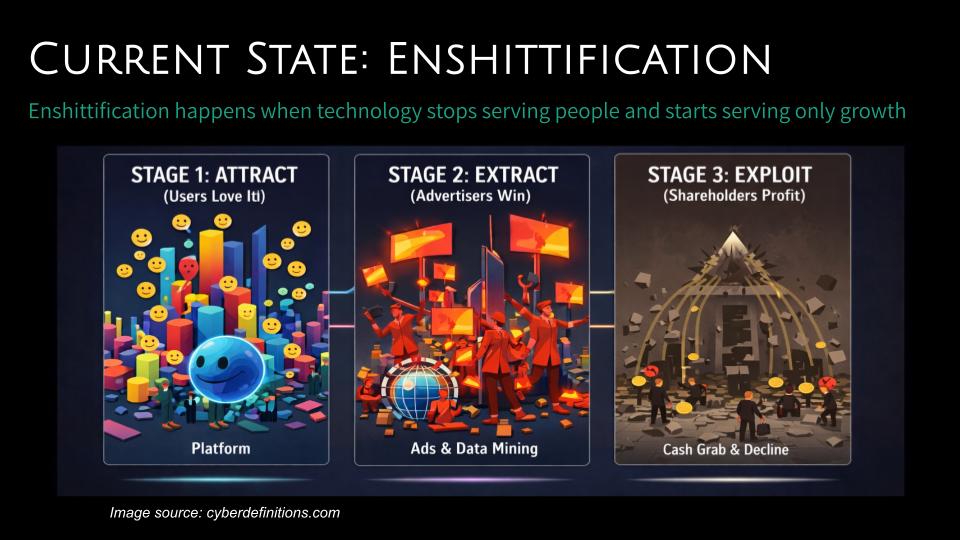
Enshittification has become the defining experience of modern technology. The “enshittification” cycle always seems to follow a pattern: digital platforms are great to users; then great to business customers; then extractive to everyone; features are hollowed out, things that once worked become brittle or break, and user experience becomes less user friendly and more hostile. Products that once felt and were useful, even liberating, slowly degrade into cluttered, extractive, manipulative systems. Platforms optimize against their users. Innovation narrows into monetization. Trust erodes. This extractive pattern has played out everywhere across the digital landscape. It is not accidental. It is the predictable outcome of technologies designed within extractive economic logic at their root: digital systems optimized for growth, control, and short-term returns, while externalizing social, ecological, and human costs. So, as this seed is, is this also how the fruit shall be? What is possible if breakdown isn’t the end of this story?
In living systems, decay is not failure but a biological process that is both a natural and necessary phase in transformation. What breaks down becomes the basis for what comes next. In the forest or the jungle, when leaves sprout and then ultimately die, they fall upon the ground and act as a regenerating soil for all that grows out of it. Such can also be true for the digital world. The question before us is not how to stop enshittification outright, but how we can transform its outcomes into the conditions for a regenerative future.
What enshittification reveals
In many ways, enshittification is a warning sign to humanity. It tells us that the systems we are building are out of alignment with the conditions required for long-term health for all of life to flourish. When platforms prioritize transaction over relationship, scale over resilience, and efficiency over care, degradation is inevitable. “Externalized” harms are made invisible by the corporation, but not its ecosystem. User experience suffers. Social trust fractures. Ecological costs accumulate. What appears as a tech problem is, at its core, a design and values problem. Seen this way, enshittification is not simply something to fight—it is something to learn from. It reveals where our assumptions about progress, value, and success are no longer viable. It shines a light on where the gravest issues lie and where systemic change is needed most.
From extraction to regeneration
The industrial technology paradigm treats failure as something to be patched, hidden, or overridden. More growth is applied as the solution to growth-driven problems. More automation is deployed to fix human harm created by automation. This feedback loop accelerates the underlying issue, and often leads to collapse of the platform or digital network itself. A regenerative approach takes a different stance, one that learns from 3.8B years of nature’s evolution. In biological terms, regeneration is the process of renewal, restoration, and tissue growth that makes genomes, cells, organisms, and ecosystems resilient to natural fluctuations or events that cause disturbance or damage. Every species is capable of regeneration, from bacteria to humans. How might we apply this universal pattern in nature to the digital technologies that humans create? Instead of asking how to preserve systems that are degrading, a regenerative approach asks:
- What no longer serves life?
- What must be allowed to end?
- What value can be recovered and reintegrated differently?
Regeneration does not mean preserving everything. It means transforming what exists into healthier forms, often by letting outdated structures dissolve or fall to the ground floor so that the new can grow out of it.
Shifting the foundations of technology
This transition begins beneath the surface– in the proverbial “soil” of technology design– at the level of intention and worldview. Most technology today is shaped by a narrow definition of value: financial return, speed, scale, disruption and dominance. When these assumptions go unquestioned, even well-meaning tools eventually reproduce harm. When these processes deviate from the natural cycles of all organisms facing entropy while seeking homeostasis, the result is chaos and the subsequent need is for a profound and necessary shift. A regenerative future seeks a shift in first principles:
- from extraction to reciprocity
- from scale-at-all-costs to contextual fit
- from control to participation
- from efficiency alone to resilience and care
Changing these foundations changes the designs and applications that rest on them. Designing for life, not just performance At the level of design and application, the difference between extractive and regenerative technology becomes tangible. Regenerative technologies are designed with their full lifecycle in mind. They account for material use, energy demand, governance, and downstream impacts. They favor modularity, reuse, transparency, and adaptability over lock-in and planned obsolescence. They also recognize that not every system should scale globally. Some technologies are healthiest when they remain local, place-based, and responsive to specific communities and ecosystems. This is not a retreat from innovation. It is an intentional evolution of it.
Technology as a participant in living systems
The deepest shift occurs when we recognize that technology is never neutral. Every system we build participates in shaping relationships—between people, between communities, and between humans and the natural world. Enshittification damages these relationships. It fragments attention, concentrates power, and erodes trust. A regenerative approach designs technology as a relational actor:
- supporting coordination rather than polarization
- enabling local agency rather than central extraction
- strengthening community resilience rather than dependency
In this framing, success is not measured only by adoption or revenue, but by whether a technology contributes to the health of the systems it touches.
What comes after enshittification
We are living through a transition period. Old models are breaking down faster than new ones are being established. This moment is uncomfortable—and full of possibility. Out of the degradation of extractive tech, we are already seeing early expressions of a different future:
- community-owned and cooperative platforms
- open-source and commons-based infrastructure
- tools for circular economies and regenerative supply chains
- technologies that support ecosystem restoration, not depletion
- governance systems that distribute power and accountability
These are not fringe experiments. They are early indicators of what grows when the conditions change.
Composting in practice: three initiatives from our directory
The principles above are not abstract. There are real life examples of this alive and well out in the wild right now. Here are three initiatives already featured in our RegenTech Directory — turning what the dominant system discards into the starting point for something of value.

Olio is a hyperlocal sharing app that redirects surplus food and household items — things destined for landfill — to neighbors who can use them. Operating across 49 countries, it diverts more greenhouse gases than it produces, making it a carbon-negative platform. What someone treats as waste becomes another person’s resource, mediated by community rather than commerce. Empower.eco turns plastic waste into a marketplace asset. Using mobile, blockchain, and tokenized plastic credits, the platform gives plastic a traceable economic value — incentivizing collection, rewarding clean-up efforts, and enabling brands to verify and certify circular sourcing across 40+ countries. By affixing value to what was previously treated as an externality, it creates the economic conditions for a functioning circular plastics economy. LiquiDonate connects retailers sitting on excess inventory with nonprofits, schools, and upcyclers who need it. Rather than costly disposal, unsold products find new purpose — and the platform automates the logistics, matching, and tax documentation that makes it frictionless enough to actually happen at scale. Each of these operates differently. What they share is the regenerative orientation at the core: waste is not the end of the story, nor is it considered waste at all. It is raw material of high value waiting for the right system to recognize it and compost it into something new.
An invitation to participate
The question is no longer whether today’s dominant tech paradigm is failing. That inconvenient truth is clear. The real question is what we do with the material it leaves behind. If we treat enshittification only as something to resist, we miss the opportunity it presents. If we treat it as a raw material for learning, redesign, and transformation, it can become the foundation for something far more resilient. The future of technology will not be built by clinging to systems that no longer work. It will be built by those willing to transform breakdown into renewal—and to design technologies that serve life, rather than extract from it.