Last week we held our inaugural State of the State: Regenerative Technology in 2026 webinar. The feedback has been tremendous, and the message that stuck: If we want to repair our relationship with the each other and the planet, we have to look at the soil our technology is grown in– the values, incentives, and the substrate of their design– not just the tools we build! Systemic regeneration doesn’t start with better UX or even better infrastructure. It starts with intentions. How technology is envisioned, financed, governed, and evaluated determines everything that grows on top of it. What does that look like in practice though?
Our work at RTP is all about ecosystem building: how can we best support the Tech ecosystem to design tech that serves the health of the whole (people, communities, economies, and ecologies) ?
One way we do this is surfacing examples, resources, and tangible patterns of where “regen tech” is emerging in the wild, and around the world. Here is the list of the 5 trends in regenerative technology we shared:
1. Remote Sensing Expands Place-Based Data
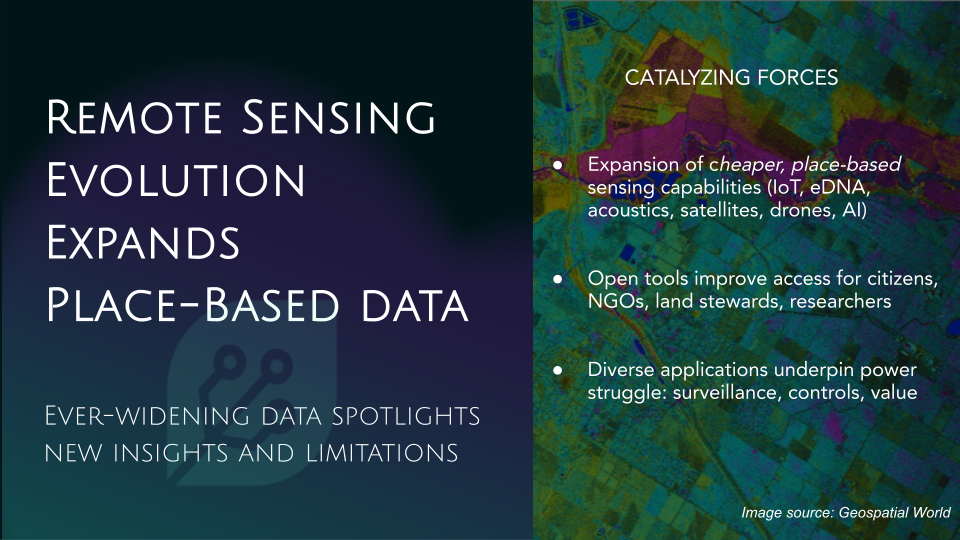
Big data abound (via cheaper and more accessible sensors, IoT, robots, eDNA, acoustics, satellites, oh my)! Beyond the big players grabbing all that data to sell or control from the “planetary” level, reduced costs and increased access is allowing more organizations, land stewards, and local communities to guide how the tech is used, and augment their own visibility and listen to what their ecosystems need to stay healthy.
Implication: Place-based data, while always incomplete, is critical for expanded awareness and accountability not just for ecological, but social and economic systemic health too.
2. Regenerative AI
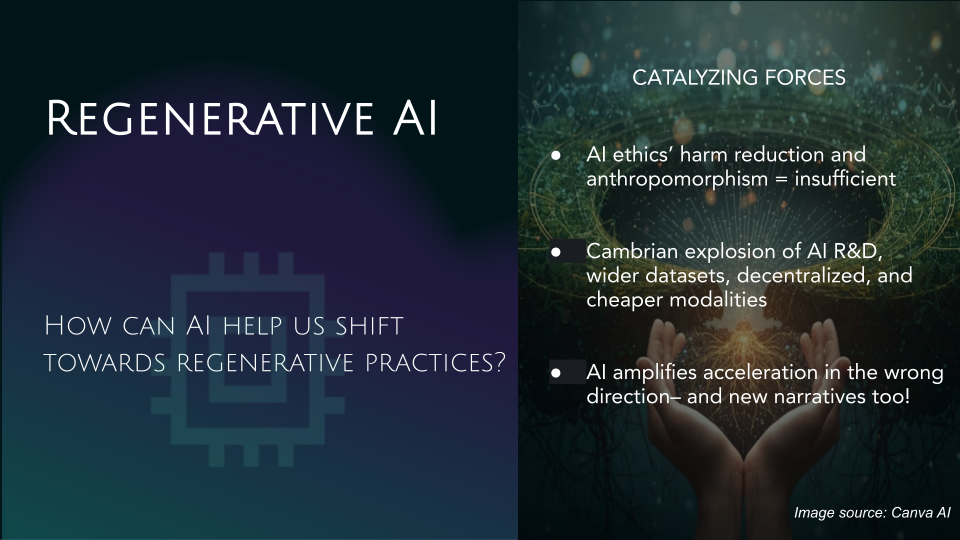
AI today is mostly energy and culture-blind, tooling for profit maximization to keep us distracted and disempowered, but the emergent trend in “regenerative AI” presents alternative narratives for this powerful technology. Regenerative AI looks to nature’s own patterns (biomimicry) to design systems that are more resilient, adaptive, and oriented toward repair and alignment between natural, human, and machine intelligence. Our presentation shares 6 categories of regenerative AI we’re seeing in the market today, and more are sure to emerge.
Implication: Now is the time to build the field of these diverse applications and infrastructures pioneering different narratives for AI as a partner that helps humanity create conditions systemic health.
3. TEK-Knowledge-y: Ancient Wisdom Meets New Tech
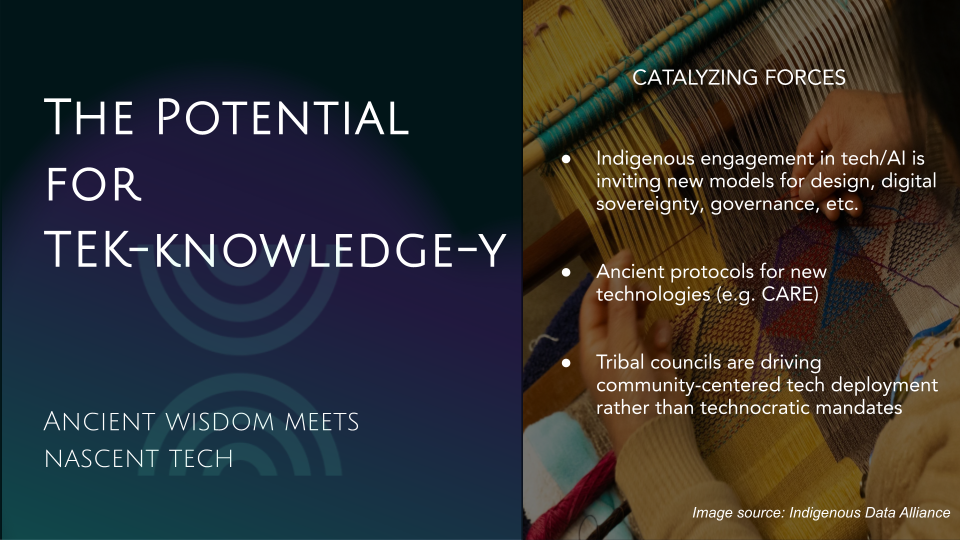
One of the most important patterns happening around the world is the meeting and mingling of Traditional Ecological Knowledge (TEK) and Indigeneity with our nascent digital tech. Frameworks like CARE (Collective Benefit, Authority to Control, Responsibility, Ethics) are redefining who has authority over data and infrastructure — centering Indigenous governance, cultural continuity, and right relationship in how technology is designed and controlled.
Implication: Dissolving the “Silicon Valley knows best” model with long-term stewardship and cultural knowledge can create more resilient, localized, and self-sovereign systems.
4. Tech for Collective
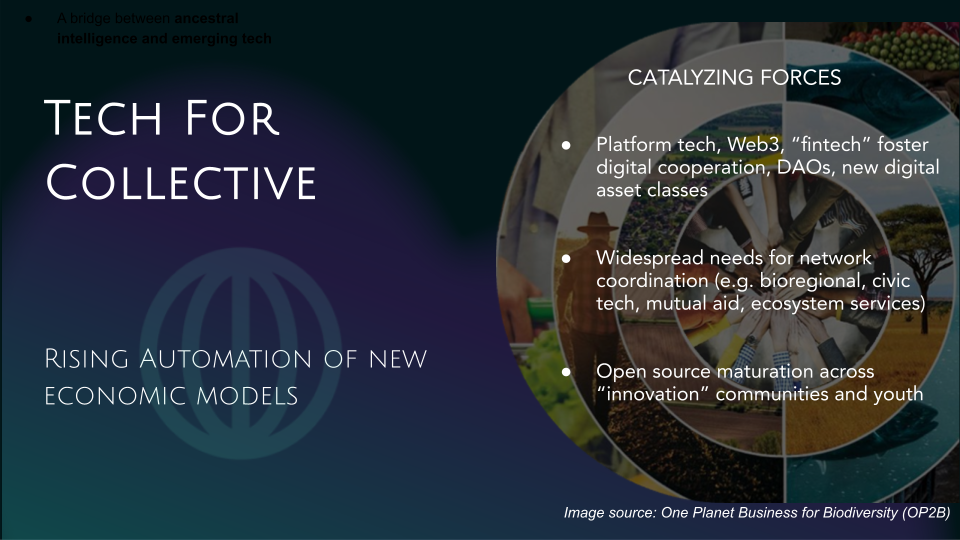
We live in a polycrisis, a time in which our ability to collectively adapt and organize is an evolutionary imperative. Widespread needs for network coordination (e.g. civic/democratic, bioregional, mutual aid, valuing ecosystem services) has a growing class of open source and other softwares emerging to facilitate how multiple stakeholders coordinate common assets, form functional cooperatives, and distribute decision-making and value more equitably.
Implication: These are powering novel economic models that challenge the dominant status quo of top-down, “take-all,” socially and environmentally unconscious business and finance models. And, can scale digitally…
5. Deepening Tech Stack Disruption
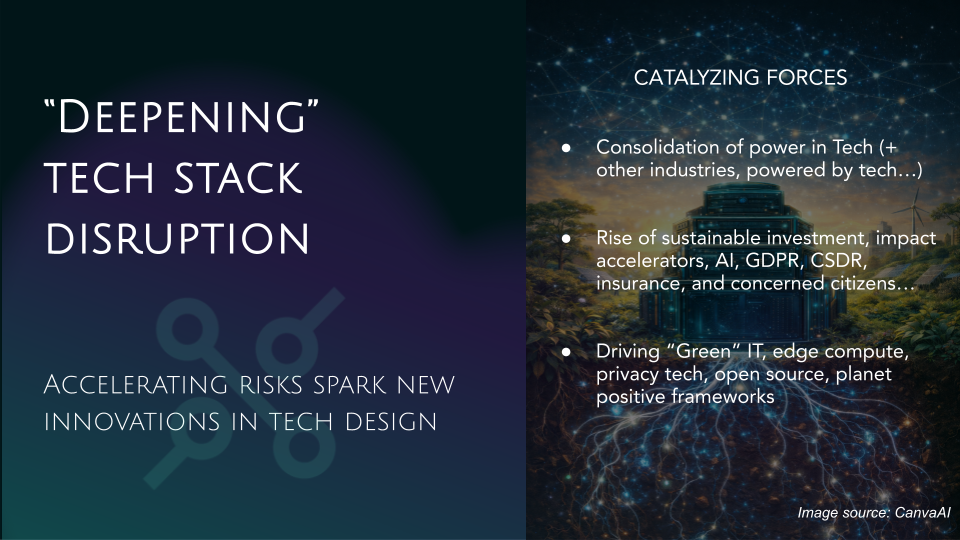
The pattern of centralization, power asymmetries and Tech oligarchy remains dominant, but diverse global forces like GDPR, insurance, impact investors and accelerators, and concerned citizens, are investing time and money in alternatives. These are sparking “green IT” innovations that address material impacts, energy efficiency, digital sovereignty, decentralization, and more deep in, and across, the tech stack.
Implication: These architectural breakthroughs help address otherwise abstract or hard-to-audit risks, while creating concrete infrastructure alternatives for a new class of innovations.
These are just some of the amazing counter narratives, models, and tools that are happening around the world, using tech to improve the lives of people, place, and the planet itself. What are you seeing? What are you working on? We’d love to hear from you!
For examples, frameworks, and a deeper dive into each of these trends, watch the recording of our event here.
Access slides here State of Regen Tech 2026 Full Slides