It seems like every day, headlines remind us of new and recurring ways Big Tech is harming society. From Facebook’s landmark legal battles over its algorithms knowingly exposing teenagers to harmful content, to Amazon’s grueling warehouse conditions, to Microsoft and Google’s race to build AI data centers in water-stressed regions of the developing world.
The world is awakening to the diverse systemic harms that Tech’s extractive and accelerationist logic is wreaking on people, planet, and our economic resilience. Meanwhile, forward thinking organizations, entrepreneurs, engineers, and the next generation are ready to develop the alternatives we all want.
But in order to shift from extractive to regenerative tech, we have to change how we design.
The question most technology designs ask is functional: does it perform, does it connect, does it scale? They tell you whether a system works. They don’t tell you what the system is working toward, or for whom, or at whose expense. They won’t tell you who made the decisions that shaped the product before it ever reached a user. Those answers live somewhere the demo never goes: in the governance structure, the capitalization table, the business model, the terms most people scroll past.
Regenerative technology changes the starting question. How does this contribute to the health of the systems it touches – the people, the communities, the ecologies in relationship with it? It’s a different frame, and it produces different designs.
We are launching a Regenerative Technology Assessment Tool to help innovators evaluate their technology through a more systemic lens.
A Framework (and a Tool) Built for This Moment
The Regenerative Technology Project has spent years developing a framework for evaluating technology not just by what it does, but by what it is embedded in. The Regenerative Tech Stack asks organizations to examine their technology across three interdependent layers and to treat all three as design inputs:
Layer 1: Intentions & Values: the soil. What worldview drives this system? How is it financed, governed, and measured as successful? If the soil is extractive, everything that grows from it will be too.
Layer 2: Design & Application is where most technology evaluation begins and ends: the features, the interface, the integrations, the infrastructure. In regenerative design, these choices remain crucial, and they are made in service of something beyond the product boundary.
Layer 3: Systems & Relationships is where technology meets the world. Every system reshapes the people and communities it enters, whether its designers intended that or not. The automobile transformed cities, labor markets, and geopolitics. Social media restructured attention, identity, and political life. AI is now doing all of that simultaneously, at speed. This layer treats those wider effects as necessary design considerations.
(Most technology is designed and evaluated almost entirely at Layer 2. Layers 1 and 3 get treated as externalities, until they become headlines…)
What the Assessment Makes Visible
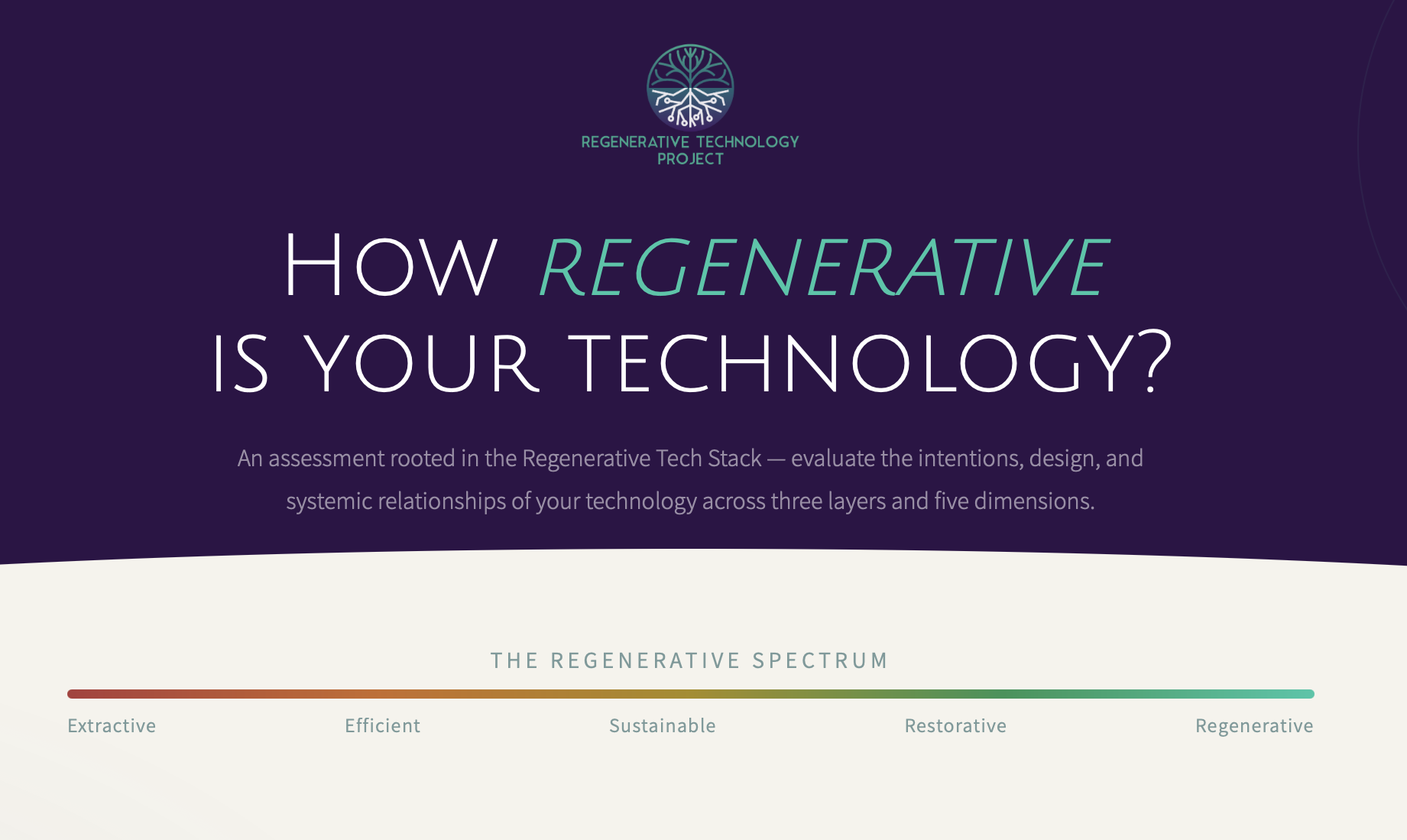
RTP built a free assessment tool grounded in the Regenerative Tech Stack. It’s a ten-minute questionnaire that walks through all three layers for your organization, technology, or initiative. It produces a scored profile on the spectrum from extractive to regenerative, with concrete next steps.
This tool is meant to offer a whole-systems view across your values and governance, your design and materiality, and the wider relationships your technology participates in. While it offers a score, we encourage you to focus less on the specific numbers and more on the ecosystemic innovation opportunities it reveals. What was invisible becomes visible.
Take the assessment at assess.regentech.co !
We welcome your feedback as it actively shapes how the tool can improve and where the tool goes next. For organizations, investors, or entrepreneurs ready to go deeper, The Regenerative Technology Project works with teams through innovation consulting, technology enablement, and facilitation. Check out our services here: https://www.regentech.co/services/.
We don’t have to accept the current trajectory of extractive tech. We can invest in and build technology that serves the health of the systems it touches rather than extracting from them. The assessment is one place to begin.