By focusing narrowly on our approach to technological design, we’re missing the greatest threats and opportunities for tech innovation!
When we design technology, we tend to focus on what we can see: code, infrastructure, and interfaces. We see the device, but what about the questions surrounding it: Who is this for? Who decides? Who benefits? Who bears the risk? What counts as success?
The answers to these questions live inside the business models, governance structures, incentive systems, and cultural assumptions—the “soil” beneath the software. Yet when we design technology, we almost never examine that soil.
The traditional “tech stack” has become the dominant way we understand innovation—what tools we use, how systems are architected, and how they scale. This approach has helped us build powerful, efficient technologies at unprecedented speed.
But it also narrows our field of vision. We are building increasingly powerful systems on invisible foundations. As technology increasingly influences economies, communities, and the planet itself, concentrating almost exclusively on technical layers is one of the greatest risks—and opportunities—in technological innovation.
What a Tech Stack gets right—and what it leaves out
Tech stacks” help people see the building blocks of a technological solution: which infrastructure, backend, frontend, interoperability, and interfaces power the function or network. Like blueprints for buildings, tech stacks are useful. They allow teams to modularize technical systems, scale globally, and build highly functional infrastructure.
When technologists talk about “tech stacks,” we focus on infrastructure and hardware, clouds and databases, backends and front ends, and deployment pipelines. We talk about speed, scale, security, efficiency, even strategy.
Traditional Tech Stack Image (source: BusinessTechWeekly.com)
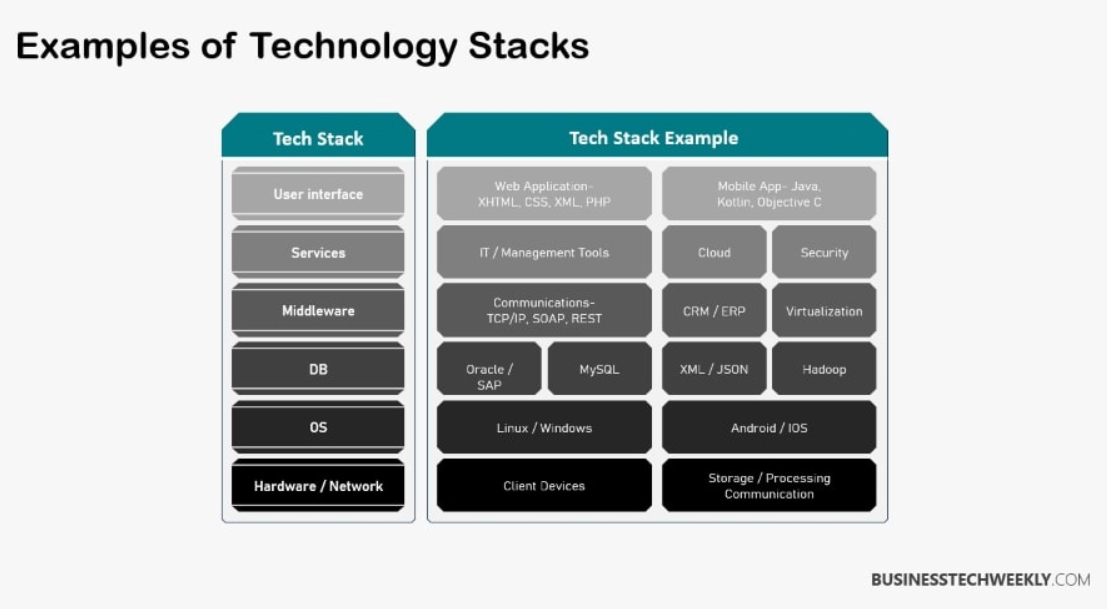
A tech stack shows how a system is supposed to work, but not why it exists, who it serves, or what its relationality with the world is beyond the product boundary. Communities, ecosystems, labor, culture, and power are treated as externalities—just as conventional business models externalize social and ecological costs from business operations.
Algorithms now determine who gets loans. Platforms decide who gets paid. Cloud infrastructure shapes energy demand. Data models determine whose reality counts. The material footprint of digital systems reshapes landscapes through mining, extraction, and waste. Yet none of this appears in the diagrams we use to design systems.
Building in a vacuum has unintended consequences. Our algorithms are executing programming with surgical precision, unaware that “solving” one problem often creates several others simultaneously. This is how well-intentioned technologies repeatedly produce unintended harms: scaling extraction, concentrating power, accelerating ecological breakdown, and fragmenting communities—while still being technically brilliant. The stack is incomplete!
The Regenerative Tech Stack
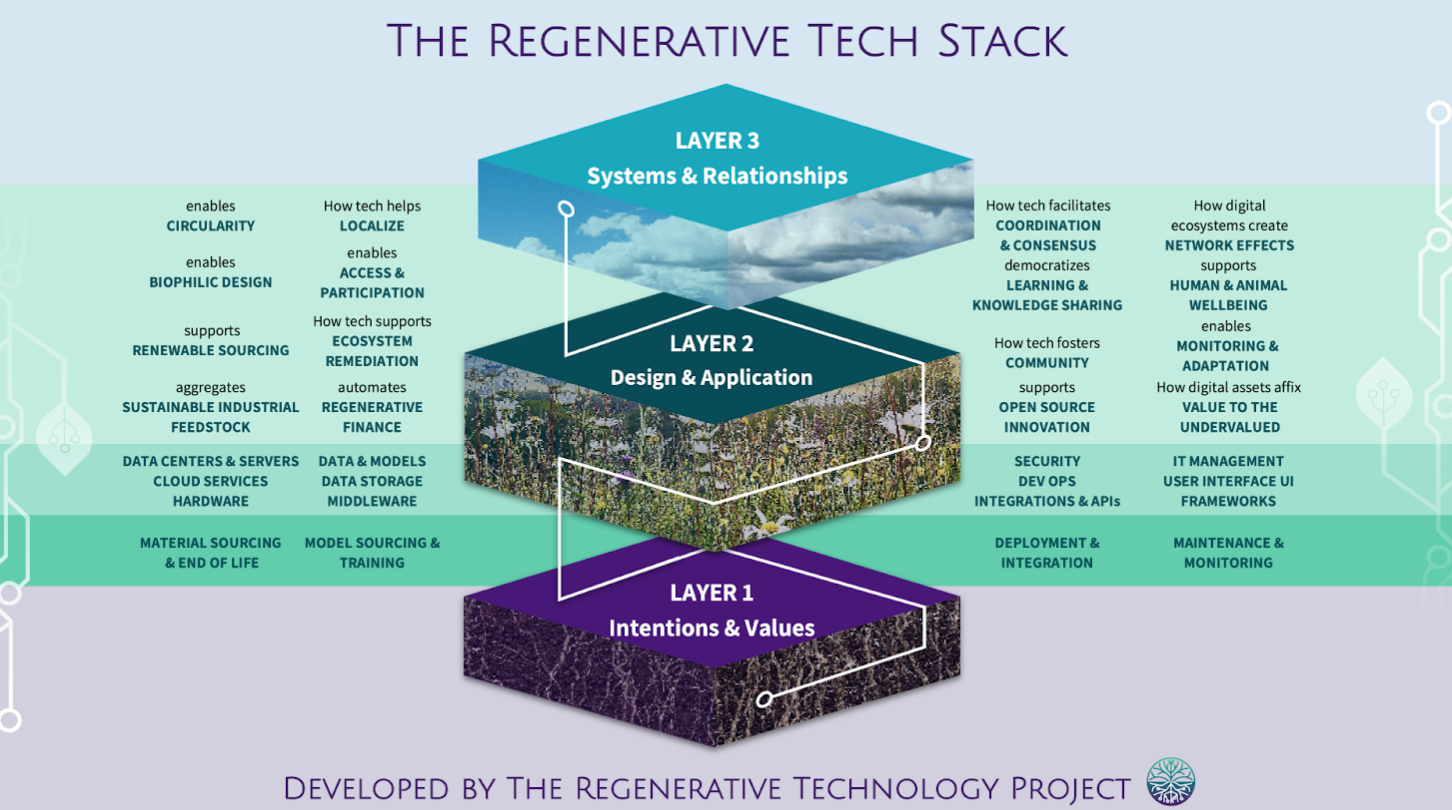
Instead of starting (and stopping) with the technology, a Regenerative Tech Stack starts with the intentions and values that inform the tech, and also extends design into the relationships.
The word “regenerative” comes from ecology, the process by which living systems create conditions for more life through restoration, resilience, and renewal. Regenerative design means going beyond harm reduction or sustainability, which often aim to reduce harm or maintain a damaged status quo. What if, instead, we design our tech to serve systemic health of the whole? Perhaps tech innovation can learn something from 3.8 billion years of R&D!
A regenerative approach to technology calls on us to see the tech stack nested within the many complex systems in which all tech is embedded. This enables stakeholders to hold foundational principles informing our designs, while also incorporating broader impacts and relationships that our tools have in the world in practical application. Recognizing the “ecology of tech,” it is an attempt to expand the aperture of how we approach technological innovation systemically.
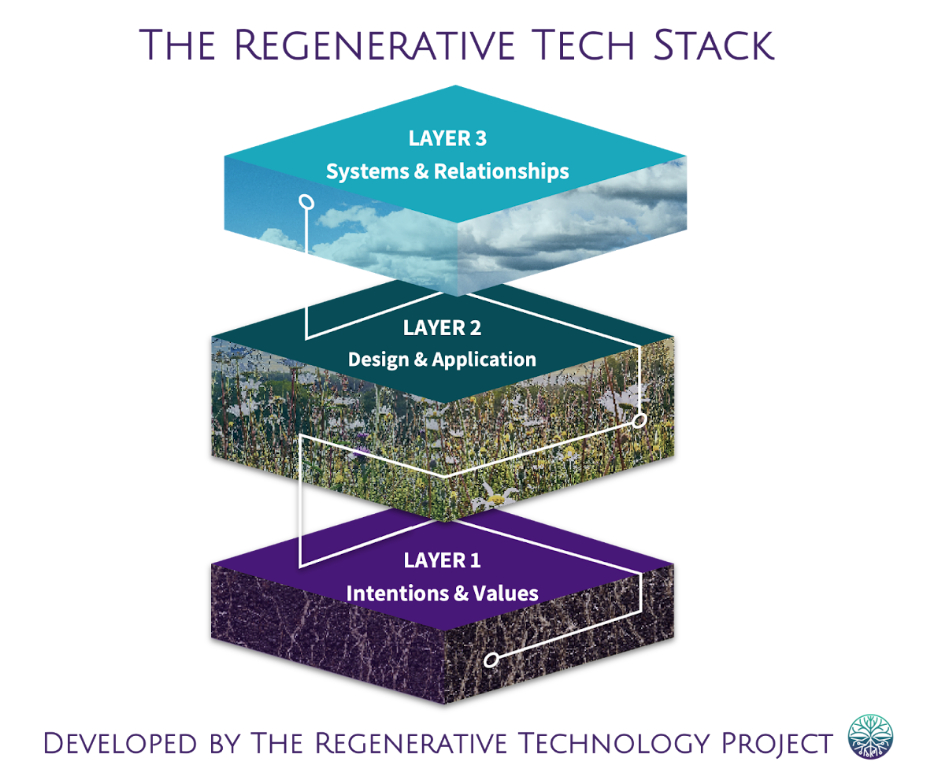
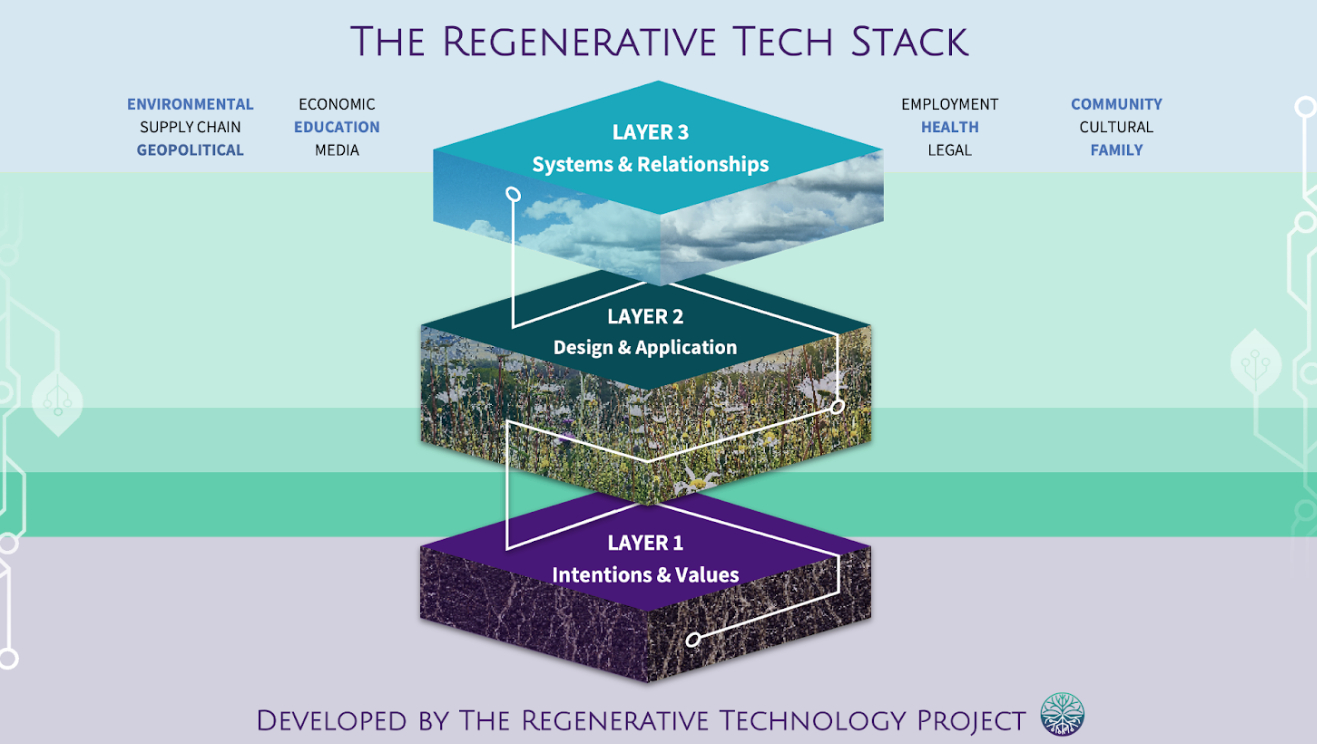
It has three interdependent layers.
- Intentions & Values
- Design & Application
- Systems & Relationships
Tech today focuses primarily on Layer 2, often undervaluing, overlooking, or altogether “externalizing” Layers 1 and 3.
In describing the shift in mindset we are talking about here, AI researcher Dr. Cornelia Walter writes of AI “it acts like a miner, extracting a specific value (engagement, yield) without concern for the integrity of the mountain left behind. A regenerative approach is different. It is modeled on the principles of living systems. An AI that is anchored in regenerative intent would act more like a gardener. A steward who doesn’t just extract vegetables but cultivates the entire ecosystem — the soil, the microbes, the pollinators; understanding that the whole is more than the sum of its parts. And that the wellbeing of one component is the cause and consequence of the health of the whole system.”
Layer 1: Intentions & Values
Every technology grows from somewhere. Layer one assesses our values: What are the intentions and cultural worldviews we bring into how we envision technological innovation? To progress? To success? To possibility? What are the principles we are designing around?
These questions shape how a system is financed, monetized, governed, and evaluated. In conventional tech, Layer 1 is dominated by venture capital logic: rapid growth, centralized control, and financial return above all else. That soil reliably produces platforms optimized for extraction—of data, attention, labor, and natural resources.
A regenerative stack asks different questions. It explores whether the goal is shareholder value or community wellbeing, speed or resilience, control or participation. It recognizes that governance models, ownership structures, and funding mechanisms are not administrative details—they are design decisions that shape everything around them.
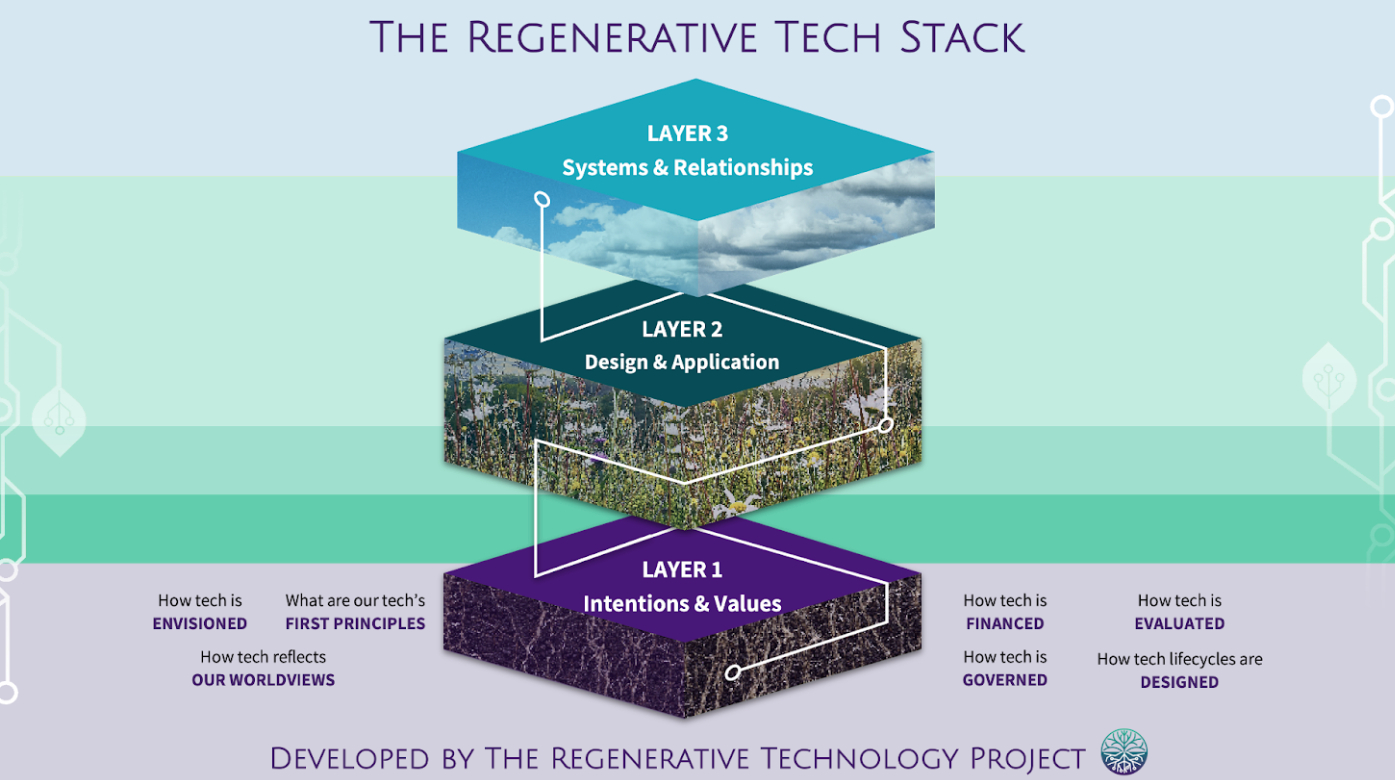
These questions may seem outside of the realm of common Computer Science curricula, yet they are the substrate from which any technology is created. Ask any entrepreneur, and they can almost always point to stories and trade-offs in Layer 1 that inform how their technologies (and business ideas) evolve. This layer is the soil.
Layer 2: Design & Application
Layer 2 is about how technologies function and what they are used for. This is the layer engineers know best: software, infrastructure, interfaces, DevOps, and deployment, as well as the applications and use case capabilities. In a regenerative stack, these components are still essential—but they are designed to support the outcomes that serve healthy and resilient systems, not just markets.
Regenerative design principles translate into concrete choices, for example:
- Circularity instead of planned obsolescence
- Local participation instead of centralized control
- Open standards instead of proprietary lock-in
- Community ownership instead of extractive platforms
- Transparency instead of black boxes
Imagine an AI platform that lets communities control their own data, govern how it is used, co-design for local needs, and optimize its infrastructure for minimal energy and material impact. Wherein the use of the platform intrinsically plants trees, affixes value to the undervalued, prioritizes community wellbeing, and contributes more than it takes from the people and places that support it. The stack is used to help organizations create cascading benefits of tech.
Our analysis finds the “field” of regenerative tech is growing rapidly with real-world examples found across sectors and around the world.
But even the best-designed tools do not exist in isolation. That brings us to Layer 3.
Layer 3: Systems & Relationships
Every technology reshapes the world around it. Layer 3 recognizes the complex reality that our technologies are always embedded within other systems, contexts, and relationships, and in turn are influencing and influenced by them. The automobile transformed cities, labor, geopolitics, and ecosystems. Social media reshaped attention, identity, and democracy. AI, blockchain, networked infrastructure, biotech, and countless other technologies are now reshaping everything at once.
Layer 3 asks how technology participates in these wider systems…How does it coordinate (or separate) people? What behaviors does it amplify? Who gains and loses agency? What patterns does it stabilize or disrupt?
Rather than wave these away as externalities, or forget them, a regenerative approach treats them as design inputs, not downstream surprises. Technology becomes not just a product—but a participant in the living systems on which we all rely.
How Builders and Investors can use the Regenerative Tech Stack
The Regenerative Tech Stack is not just a philosophy—it is a practical design tool.
For builders, it expands what “good engineering” means. The three layers help architects align technical choices with values, anticipate unintended consequences, and design systems that are adaptive, anti-fragile, and trustworthy, rather than brittle and extractive.
For investors, the framework reveals risks and opportunities that conventional due diligence misses. It makes visible how governance, ownership, and incentives shape long-term outcomes, allowing capital to flow toward technologies that strengthen real economies, restore ecosystems, and build durable social trust. In an age of systemic volatility, regenerative design is not idealism—it is risk management and compounding value creation at the broadest scope.
Why This Matters Even More in the Age of AI
Using the Regenerative Tech Stack is even more urgent in the age of AI: AI accelerates the invisible assumptions in our tech stacks—about power, profit, people, and nature— at planetary scale. What used to be slow, human, and local is now fast, automated, and global. Whatever lives in Layer 1—our beliefs about profit, people, nature, and control—is now embedded into machines that make millions of decisions per second across economies, cultures, and ecosystems.
Without a regenerative foundation, AI will simply scale extraction, surveillance, and inequality. With one, it can become a tool for coordination, care, restoration, and collective wellbeing.
Cultivate the Soil for the Future of Tech Innovation
The technologies that define this century will not be judged only by what they can do—but by what possibilities and relationships they make possible. The Regenerative Tech Stack gives us a way to build not just smarter machines, but healthier systems—technologies that restore rather than extract, that connect rather than fragment, and that create conditions for life to flourish.
The future of technology does not begin in the cloud. It begins in the soil.